Partner Sydney
"This article takes a deeper look into who can apply for an exploration license under DSHMRA and the key milestones and timelines that applicants can expect in the application process."
The first article of this four-part series introduced the US regulatory framework for deep sea mining in the US and international waters under the Deep Seabed Hard Mineral Resources Act 30 U.S.C. § 1401 et seq. (“DSHMRA”), the role of the US National Oceanic and Atmospheric Administration (“NOAA”) and the significance of President Trump’s Executive Order 14285 issued in April 2025 for invigorating corporate activity in the deep sea mining sector.
This article takes a deeper look into who can apply for an exploration license under DSHMRA and the key milestones and timelines that applicants can expect in the application process.
Obtaining an Exploration License under DSHMRA
Who can apply?
A broad range of commercial actors can access the US licensing regime. US citizens, companies organised under US law or consortia that include US entities are eligible to apply for an exploration license under DSHMRA.
In addition, applicants must:
- demonstrate that they have the technical and financial capability to conduct their proposed exploration activities;
- commit to environmental protection measures set out in the regulations implementing DSHMRA, 15 CFR Part 970 – Deep Seabed Mining Regulations for Exploration Licenses (“DSHMRA Exploration Regulations”);
- provide NOAA with a detailed exploration plan outlining the geographic area for the proposed exploration activities and the proposed methods and timelines for the exploration work; and
- provide a preliminary environmental impact assessment with mitigation measures and a safety and compliance plan for their activities.
What is the application process?
Obtaining an exploration license issued by NOAA is a multi-stage process that is designed to be transparent, systematic and commercial, while ensuring the applicant’s compliance with US regulations and environmental considerations.
Individual timelines may vary depending on the scale of the proposed exploration project, however applicants can generally expect a clear sequencing of steps from submission to approval under the DSHMRA Exploration Regulations.
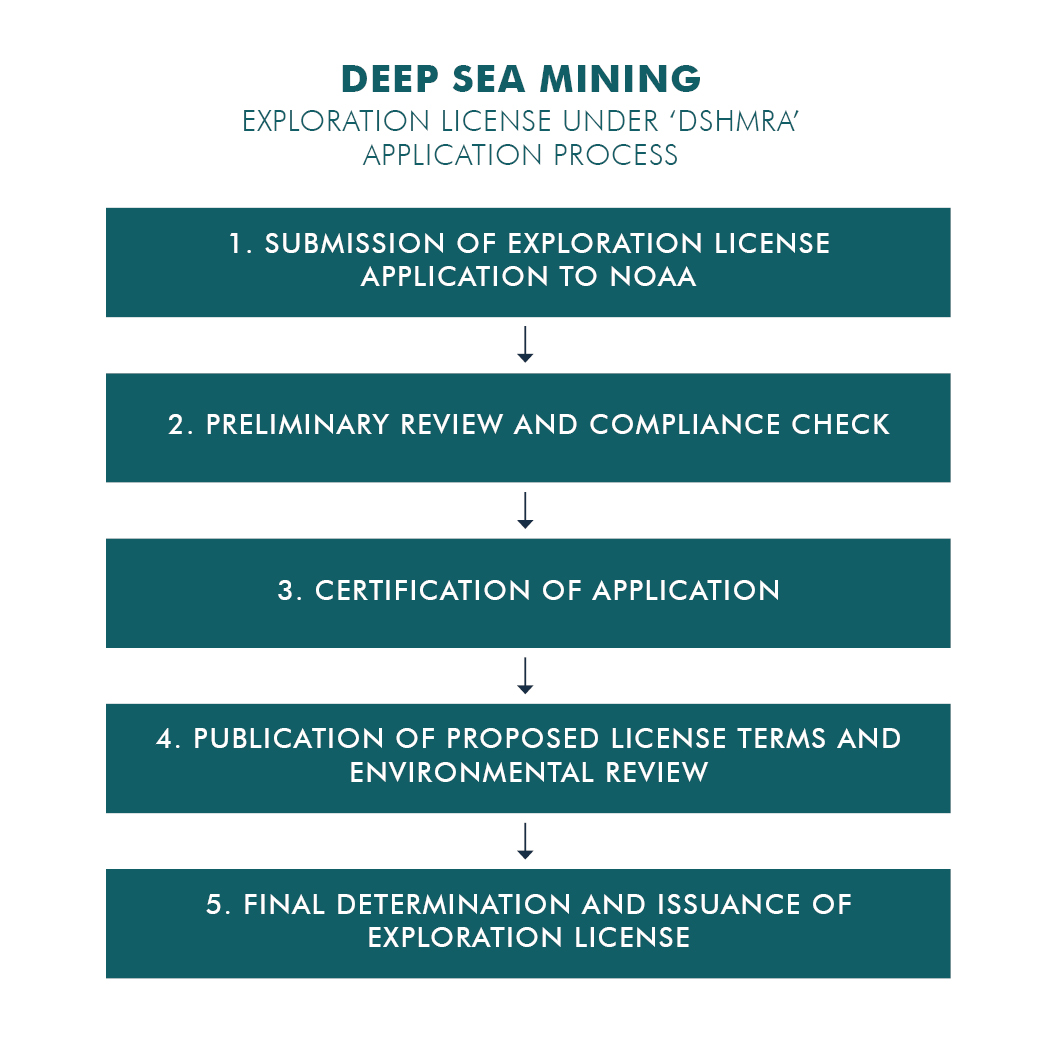
Key milestones throughout the application process are:
1. submission of exploration license application to NOAA:
- the applicant applies to NOAA, including among other things, a detailed exploration plan and a preliminary environmental impact assessment of its proposed exploration activities;
Key contacts

Partner New York

Counsel New York

Senior Associate Sydney

Senior Associate Sydney
"Obtaining an exploration license issued by NOAA is a multi-stage process that is designed to be transparent, systematic and commercial, while ensuring the applicant’s compliance with US regulations and environmental considerations."
2. preliminary review and compliance check:
- NOAA issues a written notice assessing whether the submission is in full or substantial compliance. If clarifications are needed, the applicant is given an opportunity to refine and complete its application;
3. certification of application:
- once the application is deemed complete, NOAA undertakes a comprehensive certification process comprising consultations with various US federal agencies and interested parties who may provide recommendations or submit written comments on the application. This step ensures that the application aligns with US regulatory and policy considerations across government;
4. publication of proposed license terms and environmental review:
- once the application is certified and NOAA decides to propose the issuance of an exploration license, NOAA then prepares proposed terms, conditions and restrictions, as well as a draft Environmental Impact Statement (“EIS”);
- the proposal to issue an exploration license, together with the proposed terms, conditions and restrictions, and the draft EIS are published in the US federal register for public comment. Consultations between NOAA and other US federal agencies continue to refine the proposed terms, conditions and restrictions;
- NOAA also holds a public hearing on the exploration license application and the draft EIS, at which time the public has a further opportunity to comment;
5. final determination and issuance:
- following the completion of public consultations and consultations with US federal agencies, NOAA makes a final determination on issuing an exploration license; and
- if an exploration license is granted, NOAA’s decision is published in the US federal register, together with a final EIS and the terms, conditions and restrictions associated with the license.
The application process under DSHMRA involves a thorough review of the exploration plan and environmental assessments and consultations are required with multiple stakeholders and US federal agencies.
Key Considerations
"Navigating the exploration license application process under DSHMRA requires thorough preparation and knowledge of the applicable regulations and timelines."
Thorough preparation leads to efficient progression: applicants should be prepared to provide NOAA with a detailed exploration plan setting out the proposed exploration activities, the methods and timelines for the exploration work, together with a preliminary environmental impact assessment and proposed safety and compliance measures. Well-prepared applications can progress through NOAA’s review stages more efficiently. Early investment in planning helps ensure alignment with regulatory expectations.
Transparency and public engagement: public consultation is a component of environmental review processes in the US. This enhances credibility and supports long-term planning by ensuring that key issues are identified early and addressed in a constructive manner. The opportunity for the public to participate in this process ensures that there is transparency and accountability in NOAA’s review of the application.
Clear avenue for administrative review: applicants also have established mechanisms under the DSHMRA Exploration Regulations to seek review of NOAA decisions, providing additional certainty and reinforcing the overall predictability of the regulatory framework.
Navigating the exploration license application process under DSHMRA requires thorough preparation and knowledge of the applicable regulations and timelines. By understanding the process, applicants can strategically prepare and position themselves to meet the regulatory requirements and enhance their likelihood of successfully obtaining a license to explore the deep sea.
Key contacts
Partner Sydney
Partner New York
Counsel New York
Senior Associate Sydney
Senior Associate Sydney